We use essential cookies to make our site work. With your consent, we may also use non-essential cookies to improve user experience, personalize content, customize advertisements, and analyze website traffic. For these reasons, we may share your site usage data with our social media, advertising, and analytics partners. By clicking ”Accept,” you agree to our website's cookie use as described in our Cookie Policy. You can change your cookie settings at any time by clicking “Preferences.”
Design My Trip
Skip to main content
SightseeingParis

Bourse de Commerce: Where Renaissance Grain Storage Meets Contemporary Art

Chic Trip Team
April 17, 2026
5 min read
924 words

Discover Bourse de Commerce in Paris: François Pinault's contemporary art haven in a historic grain exchange reborn by Tadao Ando, blending Renaissance columns, neoclassical domes, and modern concr...

Exterior view of Bourse de Commerce's iconic circular building with iron-glass dome in Paris

François Pinault's 10,000-piece contemporary art collection found its Parisian home in 2021 inside an 18th-century circular grain exchange transformed by architect Tadao Ando into 6,800 square meters of exhibition space. The Bourse de Commerce combines four centuries of architectural history—a Renaissance column, neoclassical circular plan, 1889 iron-and-glass dome, and Ando's signature concrete cylinder—into a venue that positions contemporary art against Paris's monumental past rather than isolating it in sterile white cubes.

The Building's Four-Century Evolution

The site's history begins with Catherine de Medici's 16th-century palace, of which only the Colonne Médicis—Paris's first freestanding astronomical observation tower—survives. In 1767, architect Nicolas Le Camus de Mézières constructed a circular grain exchange (Halle aux Blés) on the demolished palace grounds, designed to store 10,000 tons of wheat with ventilation systems protecting supplies from moisture and pests. The rounded architecture wasn't aesthetic choice but functional necessity—circular design enhanced air circulation crucial for grain preservation.

An 1812 fire destroyed the original wooden dome, replaced by François-Joseph Bélanger's spectacular iron-and-glass cupola—among Europe's earliest uses of metal to span such large interior space. When the grain exchange closed in 1873, architect Henri Blondel redesigned it for the 1889 Universal Exposition as the Bourse de Commerce (Commodities Exchange), where traders dealt in wheat, sugar, coffee, cotton, and rubber until computerized futures markets ended physical trading in 1998.

Tadao Ando's Architectural Intervention

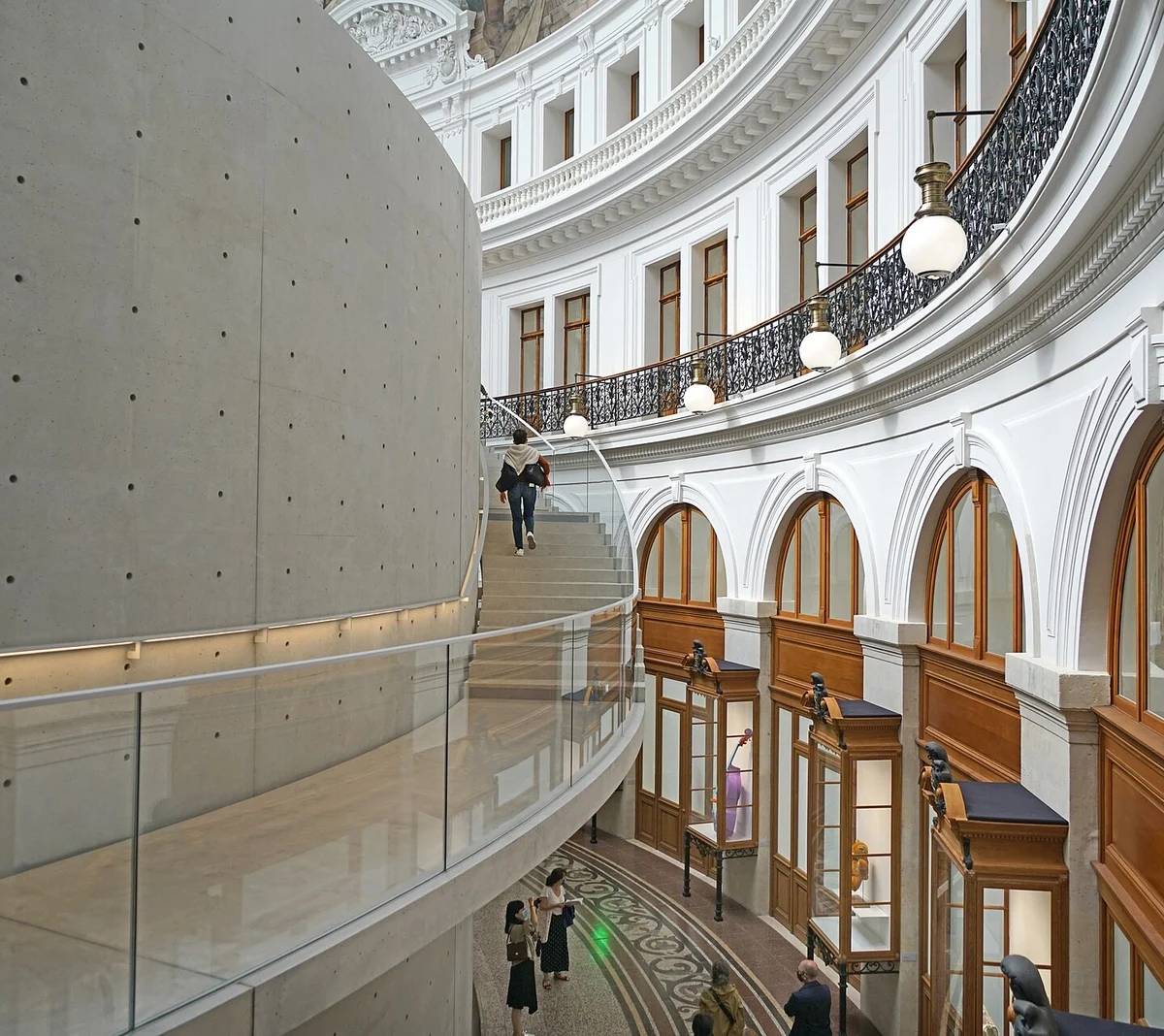
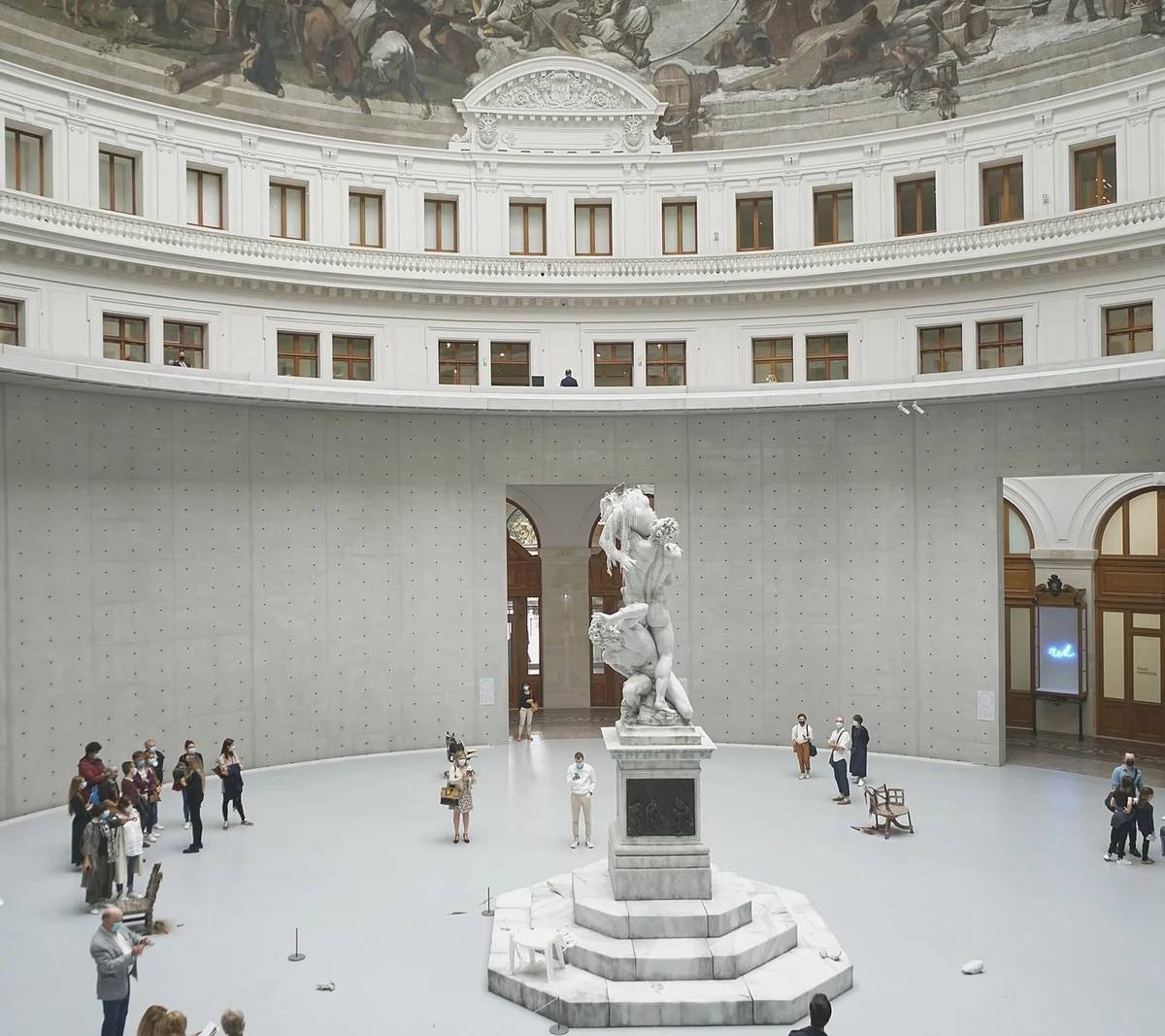
Pritzker Prize-winning architect Tadao Ando won François Pinault's commission to transform the abandoned exchange into a museum. His concept: "I drew a circle in the circle"—inserting a nine-meter-tall concrete cylinder within the existing circular structure, creating an "architecture within an architecture" designed to endure "another two or three centuries".

Artistic view of a spiral wooden staircase in Paris, capturing moody shadows and warm lighting.

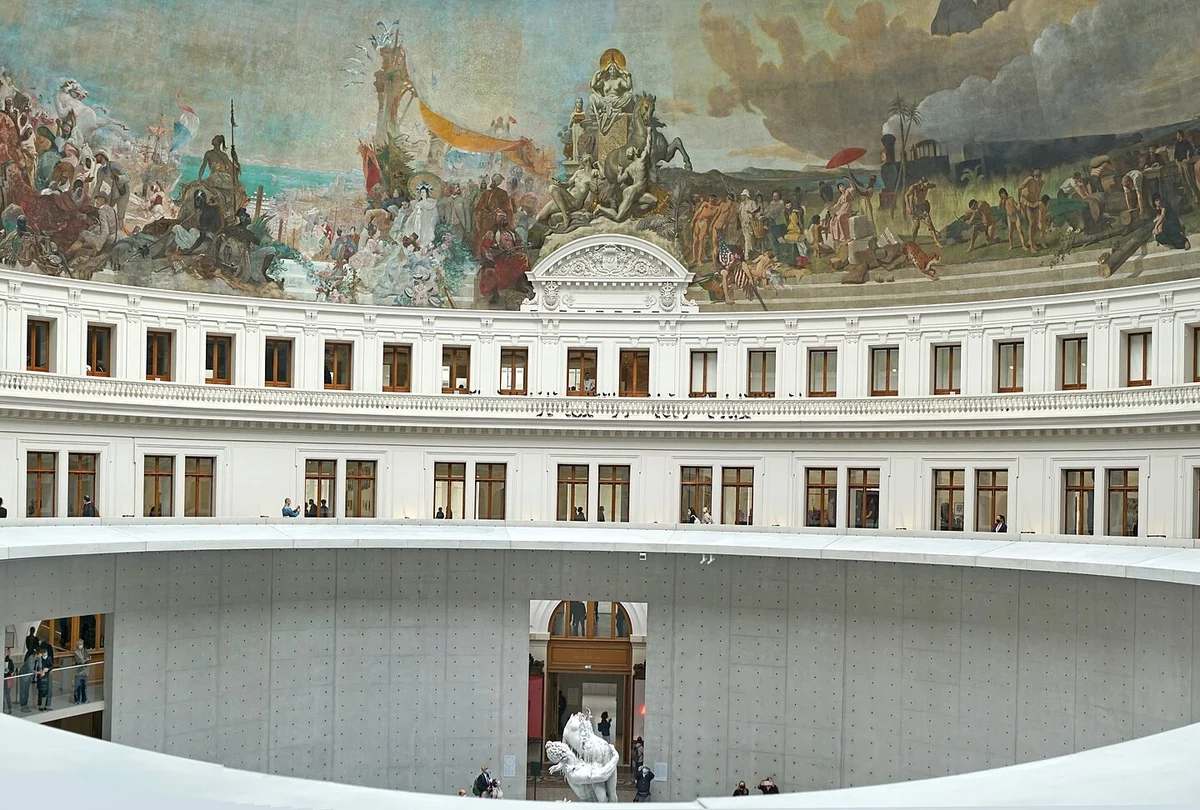
Working with Paris-based NeM Architectes, Ando meticulously restored the 19th-century steel-and-glass dome (classified as historical monument) while introducing minimalist concrete volumes that dialogue with grandiose historical elements. The concrete structure forms exhibition space on the ground floor, with external staircases wrapping around the cylinder to connect upper levels, including a circular walkway allowing close observation of the dome's 19th-century panoramic murals.

The basement extends the concrete cylinder downward, forming a ring-shaped foyer surrounding a 284-seat auditorium, plus a black-box theater for video installations and experimental performances. On the top floor, La Halle aux Grains restaurant by Michelin-starred chefs Michel and Sébastien Bras offers dining within this architectural palimpsest.

The Pinault Collection

For nearly 50 years, French businessman François Pinault assembled one of the world's largest contemporary art collections—approximately 10,000 works spanning paintings, sculptures, videos, photographs, sound works, installations, and performances. The collection deliberately mixes emerging talents with established masters from diverse cultures and origins, emphasizing political, social, racial, and gender issues that define contemporary art.

Rather than permanent display, the Bourse de Commerce presents regularly rotating exhibitions—thematic hangings from the collection, monographic shows devoted to collected artists, carte blanche projects, new commissions, and site-specific works. Past exhibitions included Charles Ray, Mike Kelley, Julie Mehretu, Pierre Huyghe, and Irving Penn, plus thematic shows like "Arte Povera" and "Forever Sixties".

2026 Cultural Season

The 2026 program explores how artists "reveal, transform, and disrupt our perception of the world". The exhibition "Clair-obscur" features modern and contemporary works from the Pinault Collection where light clashes with shadow. In autumn, for the first time ever, the museum devotes a major exhibition entirely to photography, featuring emblematic images tracing two centuries of visual culture—presented for the bicentennial of photography's invention.

From October 2025 through early 2026, "Minimal" presents over 100 major Minimalist works tracing this movement's diversity since the 1960s, when artists initiated radical approaches to art. The exhibition combines Pinault Collection masterpieces with loans from prestigious collections highlighting Minimalism's historical importance and international resonance.

The Rivalry with Fondation Louis Vuitton

The Bourse de Commerce represents François Pinault's response to Bernard Arnault's 2014 Fondation Louis Vuitton in the Bois de Boulogne. The two billionaire collectors—controlling LVMH and Kering luxury empires respectively—compete not just commercially but culturally, each funding spectacular museums that position their contemporary art collections as public gifts while reinforcing corporate prestige.

Where Arnault commissioned Frank Gehry's futuristic glass sails in a park, Pinault chose Ando's restrained concrete insertion within historical fabric steps from the Louvre. The architectural strategies mirror collecting philosophies: Gehry's extroverted spectacle versus Ando's introverted contemplation, both serving competitive vanity disguised as cultural philanthropy.

A stunning view of a richly decorated glass dome ceiling in Paris, France.

Visiting Practicalities

The museum operates at 2 Rue de Viarmes in the 1st arrondissement, accessible via Métro Line 1 (Les Halles station), placing it within walking distance of the Louvre. Timed tickets cost €14 and include audio guides. A combined ticket (€38) provides admission to both Bourse de Commerce and Fondation Louis Vuitton—economical for visitors wanting to compare rival billionaire collections.

Beyond exhibitions, the venue programs conferences, guided tours, workshops, film screenings, concerts, and performances, positioning itself as multidisciplinary cultural center rather than conventional museum. The architectural restoration alone justifies visits—Ando's concrete intervention against the 19th-century panoramic cupola creates spatial drama that contemporary art merely inhabits rather than dominates.

The Bourse de Commerce succeeds by refusing to erase history for contemporary art's benefit. Ando's concrete cylinder respects the grain exchange's circular logic while creating exhibition space that contemporary works require. The 1889 dome hovers above, the Medici column stands outside, the commodity traders' frescoes survive—layers of Parisian history against which Pinault's collection dialogues rather than demands exclusive attention. This architectural conversation between centuries distinguishes the venue from white-cube galleries where art floats in ahistorical vacuum. Understanding that layering, recognizing how Ando negotiated between preservation and intervention, appreciating the building's grain-exchange origins—these insights transform museum visits from artwork consumption into engagement with how cities repurpose monuments without destroying them.

Tags

Photo Gallery

Artistic view of a spiral wooden staircase in Paris, capturing moody shadows and warm lighting.
A stunning view of a grand architectural dome featuring intricate detailing and grand pillars.
A stunning view of a richly decorated glass dome ceiling in Paris, France.

Ready to experience Paris for yourself?

Let Chic Trip design your perfect Paris itinerary — handpicked hotels, curated restaurants, and local expertise included.

Plan Your Paris Trip

You Might Also Like

Bourse de Commerce: Where Renaissance Grain Storage Meets Contemporary Art

Sightseeing 5 min read
Exterior view of Bourse de Commerce's iconic circular building with iron-glass dome in Paris

Discover Bourse de Commerce in Paris: François Pinault's contemporary art haven in a historic grain exchange reborn by Tadao Ando, blending Renaissance columns, neoclassical domes, and modern concr...

François Pinault's 10,000-piece contemporary art collection found its Parisian home in 2021 inside an 18th-century circular grain exchange transformed by architect Tadao Ando into 6,800 square meters of exhibition space. The Bourse de Commerce combines four centuries of architectural history—a Renaissance column, neoclassical circular plan, 1889 iron-and-glass dome, and Ando's signature concrete cylinder—into a venue that positions contemporary art against Paris's monumental past rather than isolating it in sterile white cubes.

The Building's Four-Century Evolution

The site's history begins with Catherine de Medici's 16th-century palace, of which only the Colonne Médicis—Paris's first freestanding astronomical observation tower—survives. In 1767, architect Nicolas Le Camus de Mézières constructed a circular grain exchange (Halle aux Blés) on the demolished palace grounds, designed to store 10,000 tons of wheat with ventilation systems protecting supplies from moisture and pests. The rounded architecture wasn't aesthetic choice but functional necessity—circular design enhanced air circulation crucial for grain preservation.

An 1812 fire destroyed the original wooden dome, replaced by François-Joseph Bélanger's spectacular iron-and-glass cupola—among Europe's earliest uses of metal to span such large interior space. When the grain exchange closed in 1873, architect Henri Blondel redesigned it for the 1889 Universal Exposition as the Bourse de Commerce (Commodities Exchange), where traders dealt in wheat, sugar, coffee, cotton, and rubber until computerized futures markets ended physical trading in 1998.

Tadao Ando's Architectural Intervention

Pritzker Prize-winning architect Tadao Ando won François Pinault's commission to transform the abandoned exchange into a museum. His concept: "I drew a circle in the circle"—inserting a nine-meter-tall concrete cylinder within the existing circular structure, creating an "architecture within an architecture" designed to endure "another two or three centuries".

Artistic view of a spiral wooden staircase in Paris, capturing moody shadows and warm lighting.

Working with Paris-based NeM Architectes, Ando meticulously restored the 19th-century steel-and-glass dome (classified as historical monument) while introducing minimalist concrete volumes that dialogue with grandiose historical elements. The concrete structure forms exhibition space on the ground floor, with external staircases wrapping around the cylinder to connect upper levels, including a circular walkway allowing close observation of the dome's 19th-century panoramic murals.

The basement extends the concrete cylinder downward, forming a ring-shaped foyer surrounding a 284-seat auditorium, plus a black-box theater for video installations and experimental performances. On the top floor, La Halle aux Grains restaurant by Michelin-starred chefs Michel and Sébastien Bras offers dining within this architectural palimpsest.

The Pinault Collection

For nearly 50 years, French businessman François Pinault assembled one of the world's largest contemporary art collections—approximately 10,000 works spanning paintings, sculptures, videos, photographs, sound works, installations, and performances. The collection deliberately mixes emerging talents with established masters from diverse cultures and origins, emphasizing political, social, racial, and gender issues that define contemporary art.

Rather than permanent display, the Bourse de Commerce presents regularly rotating exhibitions—thematic hangings from the collection, monographic shows devoted to collected artists, carte blanche projects, new commissions, and site-specific works. Past exhibitions included Charles Ray, Mike Kelley, Julie Mehretu, Pierre Huyghe, and Irving Penn, plus thematic shows like "Arte Povera" and "Forever Sixties".

2026 Cultural Season

The 2026 program explores how artists "reveal, transform, and disrupt our perception of the world". The exhibition "Clair-obscur" features modern and contemporary works from the Pinault Collection where light clashes with shadow. In autumn, for the first time ever, the museum devotes a major exhibition entirely to photography, featuring emblematic images tracing two centuries of visual culture—presented for the bicentennial of photography's invention.

From October 2025 through early 2026, "Minimal" presents over 100 major Minimalist works tracing this movement's diversity since the 1960s, when artists initiated radical approaches to art. The exhibition combines Pinault Collection masterpieces with loans from prestigious collections highlighting Minimalism's historical importance and international resonance.

The Rivalry with Fondation Louis Vuitton

The Bourse de Commerce represents François Pinault's response to Bernard Arnault's 2014 Fondation Louis Vuitton in the Bois de Boulogne. The two billionaire collectors—controlling LVMH and Kering luxury empires respectively—compete not just commercially but culturally, each funding spectacular museums that position their contemporary art collections as public gifts while reinforcing corporate prestige.

Where Arnault commissioned Frank Gehry's futuristic glass sails in a park, Pinault chose Ando's restrained concrete insertion within historical fabric steps from the Louvre. The architectural strategies mirror collecting philosophies: Gehry's extroverted spectacle versus Ando's introverted contemplation, both serving competitive vanity disguised as cultural philanthropy.

A stunning view of a richly decorated glass dome ceiling in Paris, France.

Visiting Practicalities

The museum operates at 2 Rue de Viarmes in the 1st arrondissement, accessible via Métro Line 1 (Les Halles station), placing it within walking distance of the Louvre. Timed tickets cost €14 and include audio guides. A combined ticket (€38) provides admission to both Bourse de Commerce and Fondation Louis Vuitton—economical for visitors wanting to compare rival billionaire collections.

Beyond exhibitions, the venue programs conferences, guided tours, workshops, film screenings, concerts, and performances, positioning itself as multidisciplinary cultural center rather than conventional museum. The architectural restoration alone justifies visits—Ando's concrete intervention against the 19th-century panoramic cupola creates spatial drama that contemporary art merely inhabits rather than dominates.

The Bourse de Commerce succeeds by refusing to erase history for contemporary art's benefit. Ando's concrete cylinder respects the grain exchange's circular logic while creating exhibition space that contemporary works require. The 1889 dome hovers above, the Medici column stands outside, the commodity traders' frescoes survive—layers of Parisian history against which Pinault's collection dialogues rather than demands exclusive attention. This architectural conversation between centuries distinguishes the venue from white-cube galleries where art floats in ahistorical vacuum. Understanding that layering, recognizing how Ando negotiated between preservation and intervention, appreciating the building's grain-exchange origins—these insights transform museum visits from artwork consumption into engagement with how cities repurpose monuments without destroying them.

Ready to experience Paris for yourself? Plan Your Paris Trip with Chic Trip - bespoke itineraries, handpicked hotels, and local expertise.

Paris Art Contemporary Museums Tadao Ando Luxury Travel Paris Cultural Heritage