Napoleon's Shadow: Grand Monuments and Forgotten Relics of the Empire
History 8 min read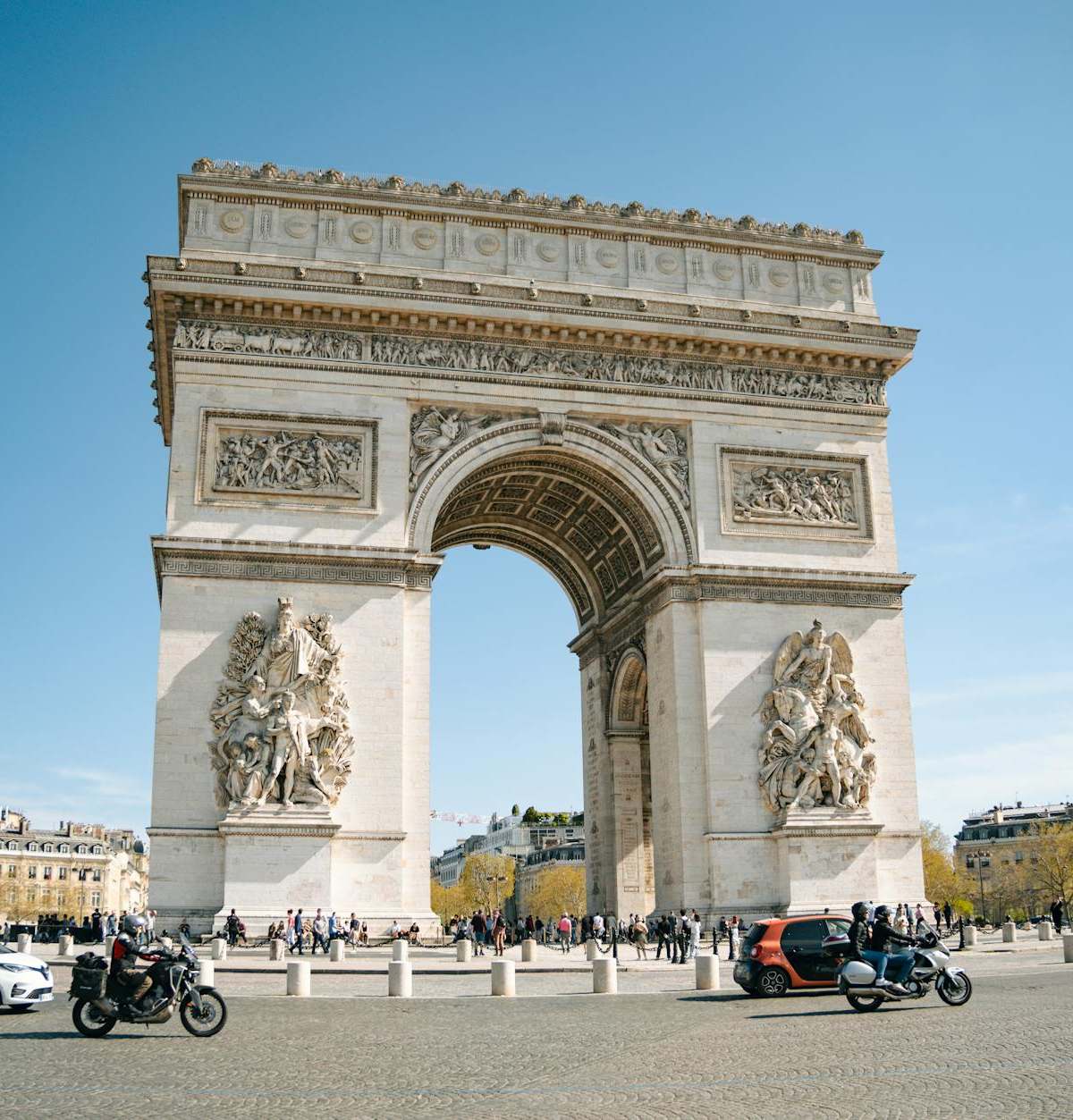
Quick answer
Uncover Napoleon's enduring legacy in Paris: from the majestic Arc de Triomphe to hidden relics like dusty bicorne hats and quiet fountains. Explore grand monuments and forgotten treasures that def...
Paris wears Napoleon like a scar that never quite healed. Two centuries after his death on Saint Helena, the city he shaped remains impossible to understand without him—the boulevards he ordered carved through medieval tangles, the monuments he commissioned to immortalize victories that didn't last, the fountains still flowing with water from canals he decreed into existence. Some of his legacy towers over major intersections, impossible to miss. Other pieces hide in plain sight: a fountain on a quiet street, a bicorne hat gathering dust in an old café, names carved into marble that most visitors walk past without noticing.
The Monuments Everyone Sees (But Few Really Understand)
Arc de Triomphe
Napoleon laid the first stone on August 15, 1806—his 37th birthday—to celebrate his Grande Armée's victories. He wanted Rome's scale, something massive enough to dwarf everything around it. The irony: he never saw it finished. Construction dragged on until 1836, fifteen years after his death, by which point the empire he'd built had collapsed and been rebuilt and collapsed again.
The arch carries the names of 128 battles from the Republic and Empire carved into its vault. Some of those battles—Austerlitz, Jena, Wagram—represent genuine military genius. Others were pyrrhic disasters dressed up as triumphs. Underneath, four massive relief sculptures tell the empire's story: Cortot's Triumph of 1810, Étex's Resistance and Peace, and Rude's Departure of the Volunteers which everyone calls La Marseillaise.
Climb to the top for 360-degree views across Paris and you'll understand what Napoleon grasped instinctively—that cities are designed to impress, and nothing impresses quite like scale.
Chic Tip: Visit at twilight when they light the Tomb of the Unknown Soldier beneath the arch. The ceremony happens daily at 6:30 PM, and watching it with the Champs-Élysées stretching behind you makes the history tangible.
Les Invalides and Napoleon's Tomb
Louis XIV built the Invalides in 1670 as a hospital for wounded soldiers, but Napoleon made it sacred. When he died in British custody on Saint Helena in 1821, his will requested burial "on the banks of the Seine among the people of France whom I so much loved". It took nineteen years of political negotiation before King Louis-Philippe finally agreed to bring him home.
The funeral procession on December 15, 1840, crossed Paris through the Arc de Triomphe, down the Champs-Élysées, past the Place de la Concorde. Along the route, eighteen statues of Victory alternated with columns crowned by imperial eagles. Half a million people lined the streets to watch the coffin pass.
The tomb itself sits in a circular crypt beneath the golden dome, designed by architect Visconti and completed in 1861. The sarcophagus—carved from rare red quartzite hauled from Russia—rests on green granite from the Vosges. Inside: five nested coffins containing Napoleon in his Colonel's uniform with his Légion d'Honneur sash, his hat resting on his legs. Twelve Victory statues by Pradier stand against the crypt's pillars, while marble bas-reliefs depict episodes from his reign.
His son, the King of Rome, lies in a side vault—brought here by the Nazis in 1940 as a propaganda gesture. Two chapels hold his brothers Joseph and Jérôme. The entire complex functions as a temple to Napoleonic glory, which was precisely the point.
Chic Tip: The Musée de l'Armée upstairs holds Napoleon's actual belongings: his grey coat, his hats, his saddle from the coronation, his sword from Austerlitz, even his stuffed horse "Le Vizir". Most visitors skip it for the tomb. Don't.
La Colonne Vendôme
At 44 meters tall, this column rises from Place Vendôme like a giant's finger pointing at heaven. Napoleon commissioned it between 1806 and 1810 to commemorate Austerlitz and honor his Grande Armée, modeling it after Trajan's Column in Rome. The bronze plating comes from melted-down Austrian and Russian cannons captured in battle, wrapped in a spiral depicting military scenes and trophies.
The Communards destroyed it in 1871, then the government rebuilt it. A statue of Napoleon in Roman imperial robes stands on top, because subtlety was never the empire's strong suit.
Chic Tip: You can't climb it, so appreciate it from the square while having coffee at one of the overpriced cafés. Sometimes spending €6 on espresso buys you time to actually look at something.
The Relics Nobody Notices
Fontaine du Fellah
At 42 Rue de Sèvres, tucked near the Vaneau metro, this Egyptian-style fountain commemorates Napoleon's 1798 campaign in Egypt. The statue—modeled on representations of Hadrian's favorite Antinoüs—depicts a fellah (Egyptian peasant) in neo-Egyptian style. It was one of fifteen fountains commissioned in 1806 when the Canal de l'Ourcq opened, bringing clean water to Paris.
Most people walk past without noticing. It's just a fountain on a residential street, except it's also evidence of how Napoleon's imperial ambitions—Egypt, Italy, Prussia—got translated into public infrastructure back home.
Chic Tip: Combine it with a visit to Bon Marché department store two blocks away. The fountain makes a better Instagram photo than you'd expect.
Le Procope's Bicorne
The oldest café in Paris opened in 1686 at 13 Rue de l'Ancienne Comédie, serving coffee to Voltaire and Rousseau before the Revolution. According to legend, a young Napoleon Bonaparte dined here one evening and couldn't pay the bill, so he left his bicorne hat as collateral. Whether the story's true or not, a bicorne hangs on the wall today, preserved behind glass like a holy relic.
The restaurant still operates, serving traditional French food surrounded by historical artifacts and the ghosts of everyone who ever argued politics over wine here.
Chic Tip: Request a table near the back room where you can see the hat without craning your neck past tourists. The beef bourguignon is solid if unspectacular.
Fontaine du Palmier
Place du Châtelet holds another Napoleonic fountain—this one commissioned in 1806 to commemorate victories in Italy, Prussia, and Egypt while providing free drinking water to Parisians. A statue of Victory brandishes laurel crowns atop a column decorated with palm fronds, hence the name.
It's surrounded by traffic now, easy to ignore while rushing toward the metro. But pause for thirty seconds and consider that this was propaganda engineering: military triumph translated into civic infrastructure, conquest made useful.
Chic Tip: View it from Café de la Mairie du 1er across the square. The terrace gives you perspective and a seat.
The Marshals' Names on Paris Streets
Paris has no Avenue Napoléon—the Third Republic erased that honor in 1877 to avoid offending republican sensibilities. But the Boulevards des Maréchaux that ring the city's outer arrondissements all honor Napoleon's marshals: Ney, Murat, Masséna, Kellermann, and more. Several avenues radiating from Place Charles de Gaulle carry the names of imperial battles: Wagram, Iéna, Friedland.
Walk these streets and you're tracing the outline of an empire through its generals and victories, a memorial system designed to make forgetting impossible.
Chic Tip: Père Lachaise Cemetery in the 20th holds the actual graves of many marshals and generals: Murat, Masséna, Ney, Kellermann, plus scientists like Champollion and artists like David. It's a more honest monument than most—just names and dates, without the gilding.
Napoleon III Apartments at the Louvre
Most visitors sprint through the Louvre toward the Mona Lisa and miss the Napoleon III apartments in the Richelieu Wing. These rooms remain almost exactly as they were in 1861—gilded, opulent, absurdly over-decorated in the Second Empire style that was trying desperately to recapture the First Empire's glory. It's not Napoleon Bonaparte's Paris, but it shows how his nephew tried to resurrect that mythology through sheer decorative excess.
Chic Tip: The Richelieu Wing stays quiet compared to Denon where the crowds cluster. These apartments make a perfect respite when you're museum-fatigued and need beauty without effort.
Tracing Napoleon's Paris means understanding how leaders use architecture to write history in stone, hoping the buildings will outlast the complicated truths. Two centuries later, the monuments remain while the empire they celebrated is footnotes in textbooks. That tension—between what was built and what was meant—makes these sites worth visiting beyond their obvious beauty. Knowing which relics matter, which stories are true versus mythologized, and how to navigate sites tourists stampede through—that's where real exploration happens. We design itineraries around those distinctions because seeing Paris means reading the layers, not just checking boxes. If that sounds worthwhile, we're here.
Keep exploring: the five Statues of Liberty in Paris · 15 hidden gems most tourists miss · Plan your Paris trip with a local
Get our free Insider Paris Guide: the neighborhoods, restaurants and hidden corners we send our own clients. No tourist traps, no filler.
Get the free guide
Ready to experience Paris for yourself? Plan Your Paris Trip with Chic Trip - a custom route, coordinated bookings and one accountable planner.
Planning your own Paris trip? Estimate your budget with the free Paris trip cost calculator, find out how many days you need in Paris, check when to book everything in Paris, or build a day-by-day plan with the Paris itinerary planner.
About Chic Trip
A journey designed exclusively for you: a personal itinerary, restaurant recommendations refined with your feedback, approved reservations and practical details in the Chic Trip app. Your written proposal confirms the total, inclusions and booking conditions before you commit. Start with a free call or email; no payment or price acceptance is required to enquire.